Warm-up
Diaphragmatic Breath
120 seconds
Let's find some calm with your diaphragmatic breath. Gently lie on your back, knees bent and feet flat, creating a soft curve in your lower back. Now, imagine a balloon in your belly: as you slowly inhale through your nose, let that belly rise, then exhale smoothly through your mouth, letting your belly naturally fall. Really focus on letting your abdomen do the work, rather than your chest. A common mistake is forcing the breath; remember, this is a gentle, flowing movement. You've got this.
Joint Prep
180 seconds
Sweetheart, as you begin your Joint Prep, gently stand tall with feet shoulder-width apart, finding your grounded center. Now, softly inhale as you thoughtfully move into each joint rotation, exhaling smoothly as you release, imagining a gentle warm-up throughout your body. Remember to lead the movement from the joint itself, letting your breath guide the flow, rather than forcing the motion, which often looks like overarching or rushing through the movements.
Main session
Low-Impact Bone Hops
3 rounds. Rest 60 sec between sets.Heel Drops
10 reps
Stand tall with your feet hip-width apart and your spine long. Rise up onto the balls of your feet, then let your heels drop firmly and abruptly to the floor. Keep your legs straight so the vibration travels clearly through your ankles and up to your hips. Exhale through your mouth as your heels hit the ground to avoid putting unnecessary pressure on your pelvic floor. Avoid bending your knees to soften the landing, as this dampens the impact. You should feel a solid, bone-jarring thud that signals your skeleton to stay strong.
0 / 10Mini Pogo Hops
10 reps
Stand with your feet hip-width apart and your gaze forward. Push off the ground using your ankles to create small, rhythmic bounces as if you are a spring. Keep your knees soft and stay light on the balls of your feet without letting your heels touch the floor. Exhale gently with each landing to manage internal pressure and protect your pelvic floor. Avoid jumping too high or locking your joints, which can feel jarring. You should feel a steady tension in your calves and a gentle lift through your midline.
0 / 10Step-Ups (knee drive)
6 per side
Stand tall in front of the step with your shoulders relaxed and your core steady. Place your entire foot firmly on the surface and press through your heel to lift yourself up. As you rise, drive your opposite knee toward your chest and exhale to keep pressure off your pelvic floor. Avoid leaning too far forward or using your back leg to bounce off the floor. Focus on feeling the work in your glutes and thighs while staying balanced at the top. Lower yourself back down with a slow, landing softly on the ball of your foot.
0 / 6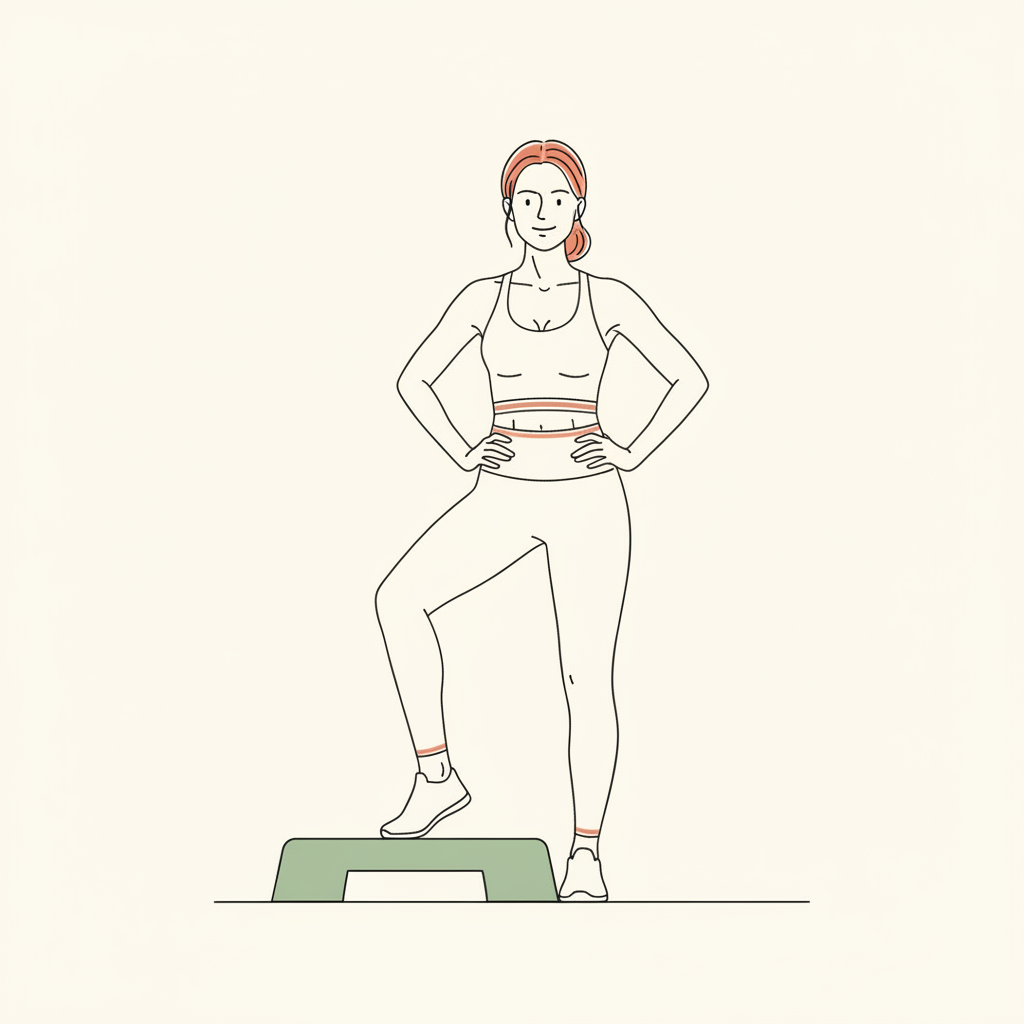
Cool-down
Calf & Hip Stretch
300 seconds
Stand facing a wall with your hands resting at shoulder height and step one foot back, keeping both heels pressed firmly into the floor. Lean your hips forward while keeping your back leg straight to lengthen the calf muscle. Take slow breaths through your nose, exhaling gently to help your muscles release without putting pressure on your pelvic floor. Avoid arching your lower back or bouncing in the stretch. You should feel a steady, comfortable pull through the back of your lower leg and the front of your hip. Focus on staying relaxed and tall as you hold this position.
Tags